Livestock as Land Stewards
Livestock as Land Stewards
At Sage & Sun Ranch, our animals are not separate from the farm. They are central to it. Every creature here plays a purposeful role in our soil restoration work and the regenerative cycle that drives this land forward. From the composting program to the rotational grazing paddocks, each animal contributes something essential to the health of this landscape.
Our herd of Huacaya alpacas is one of the cornerstones of the operation. Known for their dense, soft fleece and gentle temperament, Huacayas thrive in the high desert climate. But it is their manure that makes them truly indispensable to a regenerative system. Alpaca manure is one of the finest natural fertilizers in the world, remarkably low in nitrogen compared to other livestock waste. That means it can be applied directly to the garlic fields and rangeland without composting first, and without any risk of burning plants or damaging soil biology. It is naturally rich in nitrogen, phosphorus, and potassium in balanced proportions, and its pellet form makes it easy to spread evenly across beds and pasture. We compost it on-site alongside horse manure, building rich, biologically active soil amendments that feed microbial life and improve soil structure season after season. This is the quiet engine of our soil health program, turning what most operations consider waste into the most valuable input on the ranch.
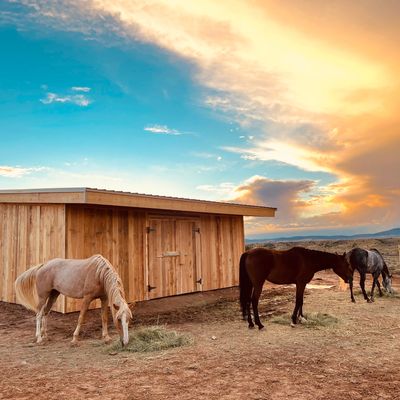
Our Arabian horses bring both beauty and function to the land. Arabians are among the oldest and most resilient breeds in the world, bred for endurance across desert terrain, which makes them a perfect match for the rugged landscape of northern New Mexico. In the pasture, the horses play a critical role in soil health through hoof impact and grazing pressure. As they move through the rotational paddocks, their hooves break up compacted soil crusts, press seeds into the ground, and create small depressions that capture rainwater, all of which stimulate biological activity beneath the surface. They work alongside a loyal donkey who serves as a natural guardian for the herd, and a mini pony who has become a beloved fixture of daily ranch life. Together, the equines are not just residents of the pasture. They are active participants in its restoration.
Our flock of alpine goats adds another critical layer to the multi-species integration. Hardy, curious, and excellent browsers, the alpines are our front line of brush control. They target invasive shrubs, woody growth, and noxious weeds that would otherwise choke out native grasses and compete with the plants we are working to restore. Their browsing habits complement the grazing patterns of the larger animals. Horses and alpacas tend to graze grasses, while the goats work the brush line and understory. This ensures more complete land coverage and eliminates the need for any mechanical clearing or chemical herbicides. In a landscape as fragile as the high desert, that distinction matters.
The chicken flock is where the regenerative cycle really comes full circle, and where composting takes on a second dimension. We raise Orpingtons, Ameraucanas, Wyandottes, and Brahmas, each breed chosen for its hardiness, temperament, and egg-laying ability in a high-altitude desert environment. Orpingtons are calm, cold-hardy dual-purpose birds that do well in both heat and frost. Ameraucanas lay colorful blue and green eggs and handle the extremes of desert climate with ease. Wyandottes are dependable, steady layers with striking laced plumage and excellent foraging instincts. Brahmas, the gentle giants of the flock, are exceptionally cold-tolerant and thrive on open ground. The chickens follow behind the larger animals through our rotational paddocks, scratching through manure, accelerating decomposition, spreading nutrients evenly across the soil, and breaking pest cycles naturally. Chicken manure itself runs hot, high in nitrogen and fast to decompose. When combined with the cooler alpaca and horse manure in our composting system, it generates the thermophilic heat needed to break down organic matter quickly, kill weed seeds, and produce a finished compost that is deeply nourishing to the soil.
Overseeing it all alongside Sunny are the ranch's two dogs. Datura, our wolf dog, and Poppy, a Chihuahua with a presence far larger than her size. Datura is a constant fixture on the land, her instincts sharp and her loyalty to the herd unwavering. She moves with the animals through the paddocks and keeps a watchful eye on the perimeter. Poppy, true to her breed's fearless nature, works right alongside Sunny during daily rounds, keeping tabs on the flock and sounding the alarm at the first sign of anything out of place. Together, they are as much a part of the ranch's working ecosystem as the livestock themselves.
Our planned rotational grazing system, with four paddocks currently in development, moves all of these animals across the pasture on a managed schedule that mimics natural grazing patterns. This prevents overgrazing, allows rest periods for native grass recovery, and keeps living roots in the ground year-round. It is the foundation of a regenerative system where every animal has a role, nothing is wasted, and the land grows stronger every season.