Pasture Restoration & Soil Health
Pasture Restoration & Soil Health
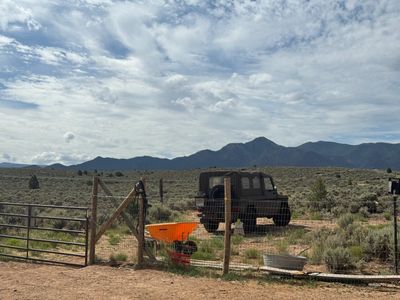
Sage & Sun Ranch carries the history of generations of rangeland use. Years of unmanaged grazing had allowed big sagebrush and prickly pear to crowd out native grasses, leaving behind compacted soil low in organic matter and an active arroyo showing clear signs of erosion.
Since taking stewardship of this land, we have been actively working to reverse that trajectory. We have brush-hogged encroaching shrubs, spread composted manure, broadcast dryland pasture seed mixes, applied hay and straw mulch for soil protection, and built earthen berms along the arroyo for erosion control. These are the first steps of a longer-term native rangeland restoration effort.
Our next phase , currently in planning , includes native grass seeding with a certified mix of western wheatgrass, Indian ricegrass, blue grama, sideoats grama, sand dropseed, and green needlegrass; a cover crop nurse mix of winter rye, Cahaba vetch, and annual ryegrass; rotational grazing infrastructure with four paddocks using traditional wood post and latilla rail fencing; and continued composting and soil amendment guided by annual soil testing and NRCS rangeland
Rooted in Holistic Management
Our approach to pasture restoration draws heavily from Holistic Management, a decision-making framework developed by Allan Savory. At its core, Holistic Management teaches that livestock, land, and people are part of one interconnected system. Rather than managing each in isolation, we define a holistic context for the ranch , a clear picture of our quality of life, what we need to produce, and the future resource base we want to leave behind , and test every decision against it.
In practice, this means we use planned rotational grazing , moving animals frequently through small paddocks so the land gets adequate recovery time between grazing events. Savory observed that in nature, large herds of wild grazers bunch tightly, trample old plant material into the soil surface, deposit manure and urine, and then move on. This cycle of impact followed by long rest is what built the deep grassland soils of the world. We replicate that pattern on a small scale with our livestock, using their hooves and biology as tools to break soil caps, incorporate organic matter, and stimulate new plant growth. Over time, this approach builds soil carbon, improves water infiltration, and increases the diversity and density of native grasses.
To learn more about Holistic Management, we recommend the Savory Institute (savory.global) and Allan Savory's book "Holistic Management: A Commonsense Revolution to Restore Our Environment."
Lessons from Masanobu Fukuoka and The One-Straw Revolution
Another deep influence on our soil health philosophy is the work of Masanobu Fukuoka, the Japanese farmer and philosopher whose book "The One-Straw Revolution" challenged the foundations of modern agriculture. Fukuoka spent decades developing what he called "natural farming" , an approach built on four principles: no tilling, no chemical fertilizers or pesticides, no weeding by cultivation, and no dependence on chemicals. His central insight was that nature already knows how to grow food and build soil; the farmer's job is not to force productivity but to step back and let natural processes do the heavy lifting.
At Sage & Sun Ranch, we apply Fukuoka's philosophy in practical ways. We never use synthetic fertilizers, herbicides, or pesticides on our pastures or garlic beds. We rely on cover cropping and mulching with straw and hay , much as Fukuoka did on his own small farm in Japan , to suppress weeds, retain moisture, and feed the soil biology. We also practice seed-ball broadcasting for native grass restoration, a technique Fukuoka pioneered for reseeding degraded land. His approach reminds us that the most powerful tools on a farm are often the simplest: observation, patience, and a willingness to work with nature rather than against it.
Fukuoka's "The One-Straw Revolution" is available through most booksellers and remains one of the most influential books in sustainable agriculture. The One Straw Revolution website (onestrawrevolution.net) offers additional context on his life and legacy.health standards.
Our Composting Partners
Good soil is built with good inputs, and two partnerships have become essential to the composting system at Sage & Sun Ranch.
We have partnered with Equine Spirit Sanctuary (equinespiritsanctuary.org), a horse rescue here in the Taos area, to pick up their horse manure on a regular basis. What would otherwise go to waste becomes a critical ingredient in our compost. Combined with the alpaca and chicken manure produced on-site, the horse manure generates the thermophilic heat needed to break down organic matter, kill weed seeds, and produce finished compost that deeply nourishes the soil. This partnership lets us build compost at a scale that matches the land we are working to restore. Learn more about their mission at equinespiritsanctuary.org/programs.
Our worms come from Brothers Worm Farm (brotherswormfarm.com) in Austin, Texas. Worm castings are among the most biologically rich amendments you can put into soil, packed with beneficial microbes, humic acids, and plant-available nutrients that no synthetic fertilizer can replicate. We apply castings directly to our garlic beds and throughout our composting system. Brothers Worm Farm breeds high-quality red wigglers and ships them to small farms and gardeners across the country. Learn more at brotherswormfarm.com.